What is it, and what does your business gain from it?
GPS tracking gives businesses a clear view of where their vehicles are, how they are being used and how journeys can be documented.
It is not just about watching a dot move across a map. It is about making everyday work easier for the people who plan jobs, prepare invoices, support customers and manage the vehicles.
For many businesses, the need starts with a few simple questions:
- Where is the vehicle?
- Who is closest to the customer?
- When did the employee arrive at the address?
- How far has the vehicle travelled?
- How can we document the journey afterwards?
With GPS tracking, the answers are available in one place.
What is GPS tracking for company vehicles?
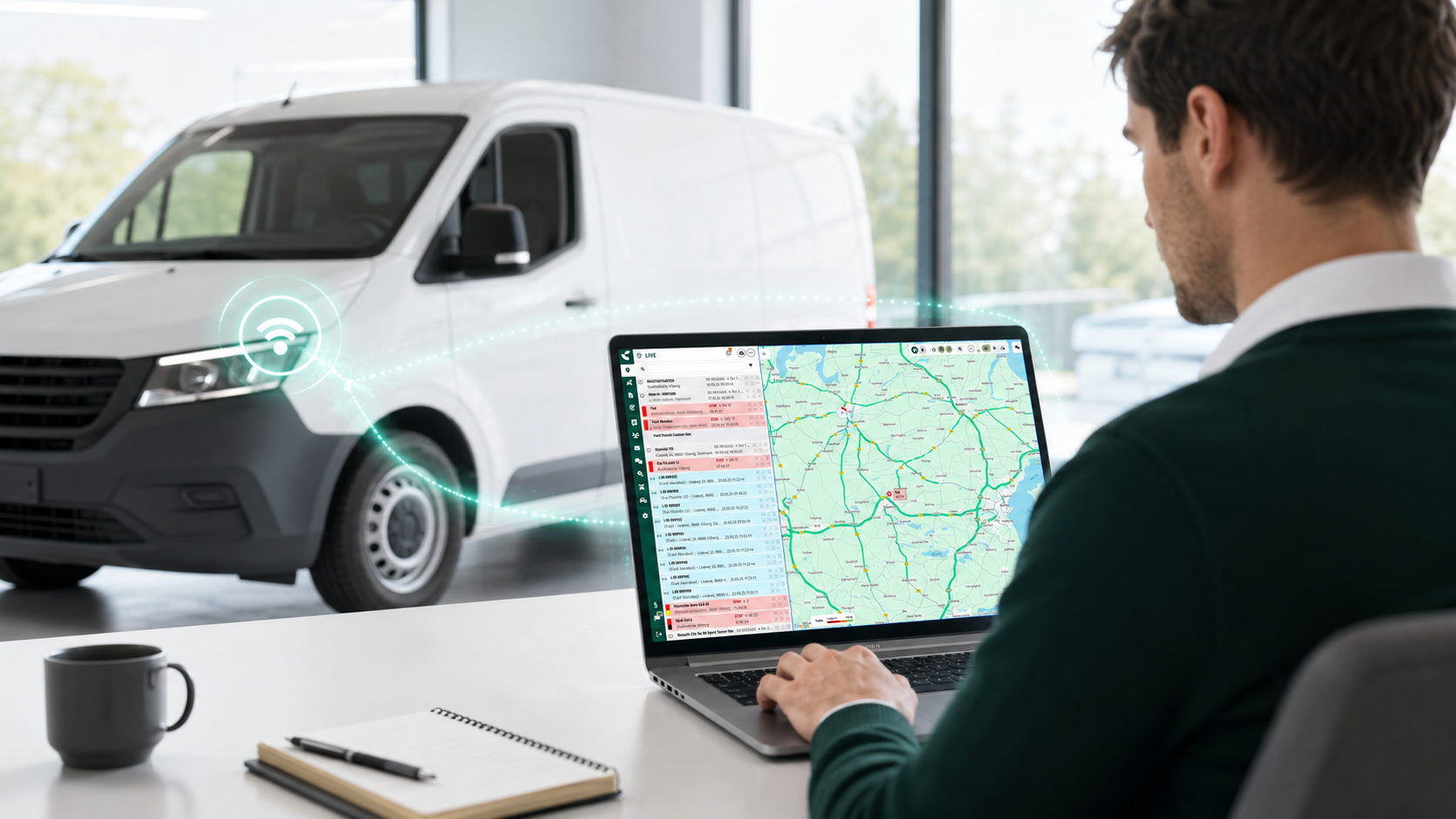
GPS tracking means that company vehicles send location data to a digital platform. From there, you can view their current location, routes, stops and journey history.
Depending on the solution, you may also have access to mileage, driving patterns, idling, fuel consumption, service intervals and reports.
This gives the business a better basis for planning the working day, following up on jobs and using its vehicles more efficiently.
What can a business use GPS tracking for?
GPS tracking can support many different tasks, but for most businesses, the main benefit is simple: better visibility during a busy working day.
When vehicles are visiting customers, travelling between jobs or spread across a large area, it can be difficult to know what is happening right now.
With GPS tracking, the office can quickly see which vehicle is closest to a new job, whether an employee is delayed or whether a vehicle is still at a previous address.
That means fewer phone calls, less guesswork and better service for customers.
Easier documentation of journeys and jobs
GPS tracking makes it easier to document when a vehicle arrived at a specific address and how long it stayed there.
This can help with invoicing, customer enquiries and internal follow-up.
Instead of searching through notes, calling employees or relying on memory, the business can find the journey history in the system.
This is particularly useful when several employees share the same vehicles or when work needs to be documented accurately for a customer.
Less manual administration
Manual recording takes time. This applies to mileage logs, working hours, mileage statements and general vehicle follow-up.
A digital solution can collect and automate much of this work. It does not remove every administrative task, but it makes information easier to manage and find when it is needed.
For many businesses, this is where the everyday value becomes most noticeable: less time spent on administration and more time available for customers, jobs and operations.
Better use of company vehicles
When a business can see how its vehicles are being used, it becomes easier to assess whether the fleet matches its actual needs.
- Are some vehicles covering far more distance than others?
- Do some vehicles remain parked for most of the day?
- Are any vehicles regularly taking unnecessarily long routes?
- Could jobs be planned more efficiently?
GPS tracking provides data that can support better decisions, both in day-to-day operations and when the fleet needs to be adjusted over time.
Insight into fuel use, idling and driving patterns
Driving costs money. Fuel, wear, maintenance and time on the road all affect the business.
GPS tracking can provide insight into routes, driving patterns and idling. This makes it easier to identify small changes that can make a noticeable difference over time.
That might mean reducing unnecessary journeys, cutting idling or planning the day’s jobs more effectively.
Is GPS tracking employee surveillance?
GPS tracking should always be used responsibly and for a clearly defined purpose.
For most businesses, the purpose is planning, documentation, customer service, operations and security.
Employees should understand which data is collected, why it is used and who has access to it. When GPS tracking is introduced transparently and used responsibly, it becomes a practical working tool rather than a means of unnecessary control.
It can also benefit employees. Journeys are documented automatically, reducing manual recording and unnecessary calls from the office during the day.
Which businesses can benefit from GPS tracking?
GPS tracking is relevant for many businesses with company cars, vans, service vehicles or other types of commercial vehicles.
Examples include:
- Tradespeople who want to document time spent at customer locations and gain a better overview of vehicles and jobs.
- Service companies that need to plan routes, respond quickly to urgent requests and keep customers updated.
- Businesses with shared vehicles that need to know who used a vehicle and when.
- Fleet managers who want to monitor mileage, service requirements, driving patterns and vehicle utilisation.
In simple terms, if vehicles are an important part of daily operations, GPS tracking can provide better visibility and support more efficient working practices.
GPS tracking should make everyday work easier
The best GPS tracking solution is not necessarily the one with the most features.
What matters is that the solution matches the business’s needs and makes everyday work easier.
For some companies, the main need is a digital mileage log. For others, it is a live map, journey history, reports, driver identification or more effective planning.
At EcoMobility, we help businesses gain a clearer overview of their company vehicles, so they can spend less time on administration and more time on the work that creates value for their customers.